Tips for White Wash

Whitewash revitalizes the sheen and texture of walls in the house. The white color makes the room appears large and maximizes absorption of the heat. It reduces odors and provides sanitary conditions in diaries, barns, poultry houses, stables, kennels or similar buildings. This article gives you tips on surface preparation, mixing solution and application method of whitewash.
Where to apply whitewash
Whitewash can be applied on plaster, brick, cement concrete surfaces and woods.
Prepare the surface
Clean the surface
Tthe surface must be cleaned of mortar droppings. Smoke particles and grease spots on old surfaces should be cleaned thoroughly.Remove dirt, dust and mold growth
All growth of moss, moulds should be removed from the surface. All loose scales, dirt and dust should be removed also.Repair the patches
The holes in patches and plaster should be filled with mortar. Let the surface dry for at least 48 hours before doing whitewash.
Prepare the solution
Step 1: Mix appropriate amount of lime and water
Mix fat lime, 1 kg un-slaked (powder) lime into about 5 liters of water to make a thin cream. Let the thin cream stay for a period of 24 hours.Step 2: Add Indigo to the solution for brightness
Screen thin cream through a clean cloth. Mix 40 grams gum into hot water for ten liters of whitewash. Add and mix Indigo (neel) up to 3 gm per kg of lime dissolved into the water.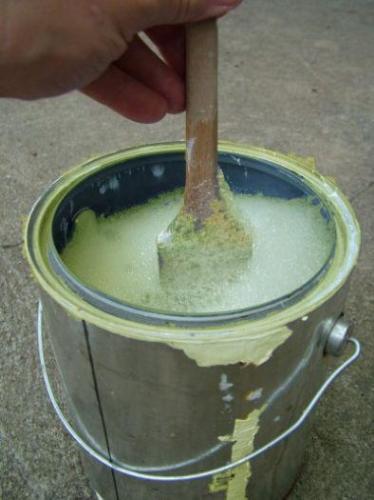
Mixture of whitewash, glue and water
(This Picture is Contributed by "Harish")
Apply whitewash thoroughly
Apply solution properly
The whitewash should be applied with brushes vertically and horizontally. Each coat should be dry before the next coat is applied.Do not leave brush marks
Brush marks should not be visible after final coat. The whitewash should be done on ceiling, prior to walls.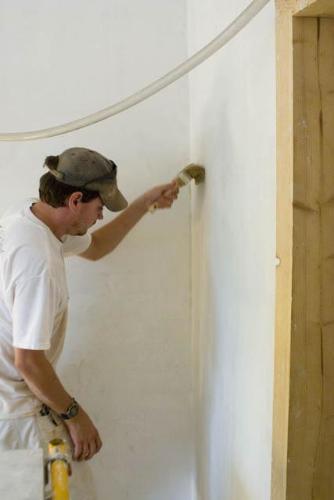
Man applying second coat of whitewash
(This Picture is Contributed by "Harish")
Getting color wash
Keep smooth and uniform finish on the surface.
Remember before doing whitewash
Use putty for small patches
Putty should be used for small unevenness in walls since it does not require any curing. Cement mortar should be used for big depressions.Mix DDL or Fevicol for adhesion
DDL, SDL, or Fevicol should be mixed into whitewash to increase adhesion. Sometimes soap and common salt should be used in whitewash to increase adhesion.Apply Indigo for brightness
Add Indigo into whitewash to increase brightness and whiteness on surfaces. Lime fast pigments can be added to whitewash to provide broad range of colors.
Benefits of whitewash
Note down
 Kota stone flooring is a subtle blend of grandeur and luxury giving the interior and exterior a gorgeous look.......
 To get maximum ventilation and natural light in your house, make sure the building is properly oriented. Orientation of building saves energy and provides comfortable living as well. This article tells you about various factors and benefits of building orientation.
 Preview some of the most impressive pictures of kitchen from GharExpert Gallery.
 A solid roof on building is very important for everybody living in the house. The roof should be constructed in a way that assures you great safety. Here are given details about different types of roofing.
 Frames of doors and windows are most important parts of your doors and windows. They are available in different size, height, width and shapes. Frames hold locks and hinges and support door and windows to shut and open easily. Here is what you need to know about different doors and windows frames.

Material for white wash

White colored kitchen with white colored appliances

designer wash basin

Top view of bathroom interior shower enclosure, wash basin , wall tiles, floor tiles and toilet

wash counter

wash basin

WASH BASIN SMALL

Oil Rubbed Bronze Washing Machine Faucet

Chrome Square Design Washing Machine Faucet

Chrome Square Design Washing Machine Faucet

Chrome Wall-mounted Washing Machine Faucet

Chrome Wall-mounted Washing Machine Faucet

Chrome Wall-mounted Washing Machine Faucet

Chrome Wall-mounted Washing Machine Faucet

Washing

light wash

wash

Washing Stone

Wash Basin

Wash Basin
Material for white wash
White colored kitchen with white colored appliances
Washing Stone

Wash Basin

Wash Basin

wash basin tile

wash

Wash basin

Wash Basin and Cabinates

WASH BASIN

wash-basin

Wash Basin

Wash Basin

wash-room

Blue Wash Basin

wash basin

wash basin
light wash
wash

Wash basin

Soothing shades of Gray, Red and white for toddler's room

White colored modular furniture in Bedroom

Traditional Kitchen Cabinets in White

Wooden Cabinets in Kitchen with white colored cooking range and hood

off white section sofa for drawing room

Modern kitchen design in white, black and purple

Black colored granite on Kitchen counter top with white colored cabinets

bathroom

white bedding set

White Bedroom furniture & designing

Black and White Staircase

Sofa Set Design in White Color

White kitchen 2

BATHROOM

Soothing color scheme

White Furniture for Living Room

Bathroom tiles Design

Blue Backsplash in kitchen with washing, microwave and dishwasher.

red n white kitchen

white touch in teak

Sofa in White

White Italian Kitchen Design

Rose Weave Bird Bath.jpg

bed-black and white

white partition

White and brown theme modern dining room furniture

White Marble Tile Kitchen Floor

Bathroom Wall paper design

Attractive white painted and marble top kitchen islands