Specification of 'Bricks Walls'

Brick walls are probably the most common building elements in construction of a house in India. These walls form basic units for creating rooms that make up a house. The walls besides being space dividers are also structural elements that transfer the load of the roof to the ground. Brick walls are constructed on strip spread or raft foundations that support the walls. The walls are constructed using bricks and mortar. These can also be constructed with various structural qualities and thicknesses.
Brickwork
Brick walls are constructed by joining bricks with cement mortar in arrangements called English Bond, Flemish Bond or Rat Trap Bond. These bonds give different external appearances to the wall. All construction systems of brick walls are such devised that vertical cross joints in any layers are staggered. The bricks thus bonded form a solid mass that does not split when the wall is loaded with live loads and dead loads.Classification of Brick Work
The classification of brick work according to the quality of brick is following.- First class brick work
- Second class brick work
- Third class brick work
First Class Brick Work
First class brick work is made by using first class bricks and cement mortar. This brick work is used for load bearing walls. It is made in rich mortar in which the cement and sand ratio is from 1:3 to 1: 6.First class bricks are identified by their uniform color and a ringing sound when struck. The bricks are equal in size and have even edges and surfaces. These bricks do not chip and don’t have any cracks. First class bricks do not absorb water more than 1/6 of their weight. There is no salty residue when the bricks are dry. First class bricks have a minimum crushing strength of 105.kg. Per sq. cm
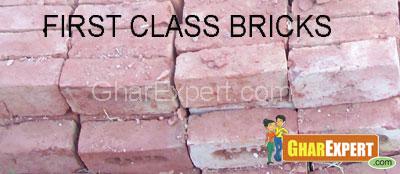
Bricks of first class quality
Second Class Brick Work
Second class bricks work is made by using second class bricks and cement mortar. These bricks also have the property of first class bricks but are not very regular or even in shape. These bricks should not be used for load bearing walls for more than two storey buildings. Second class bricks have minimum crushing strength 70.kg per sq. meter.
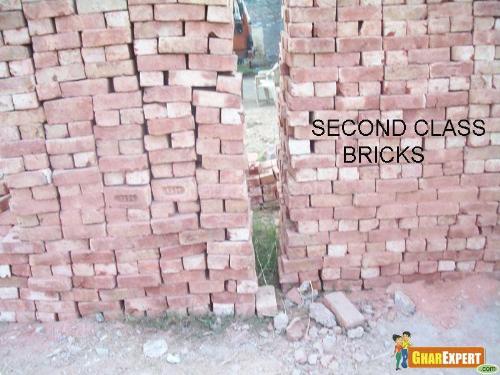
Second class quality of bricks
Third Class Brick Work
This type of brick work is made by using third class bricks and cement mortar or mud mortar. Third class brick work is not made in any Govt. work. Generally this type of brick work is made for temporary work in private sector.
Mortar
Mortar is a mix used to bind brick, stone etc to each other.It can thus be seen as a binding material that bonds bricks, stones to make a wall or for cladding purpose. Normally cement mortar is used in brickwork in present day construction though lime mortar can also be used but it requires superior craftsmanship and is hence infrequently used.
Cement Mortar
Cement mortar is a mix of cement and sand with water. The cement is binding material which requires sand as a filler material. This cement mortar mix in wet state is plastic and binds two materials when it dries. Mortar is generally defined as 1:2 or 1:3 or 1:7 etc. This means that one part of cement is mixed with 2, 3 or 7 parts of sand.
Precaution for mixing cement mortar
The following steps should be taken carefully while mixing materials for cement mortar.
- The mix should be made on a dry, clean, flat surface.
- The mix should be as per specifications.
- The mix should be by volume.
- The quantity of water should be such that the mix can be easily spread over bricks or applied on a vertical surface. Water more then required quantity may spoil the mix and it can reduce the strength of masonry.
- The mix should be used within half an hour of its preparation.
Brick Wall Foundations
Brick wall foundations are normally made as strip foundations.These are continuous along the length of wall and hence called as strip foundations. These form structural components of construction system by which the load of whole building is transferred to the ground.
Foundations are made in dug out trenches so that a hard stable surface on which the building is supported can be obtained because the top surface of the ground normally does not have load bearing capacity to take the load of the building. The other reason is that foundations can by this method be hidden from view. The architect needs to provide a foundation plan that indicates exactly where the foundation trenches are to be dug.
The foundation trenches are dug after being marked on center line principle on the site according to architect’s drawings. The size of trench varies with the thickness of walls and the load bearing capacity of the soil. The base of dug trench is rammed to solidify the surface. On rammed surface a layer of cement concrete is laid. This is normally 6 to 8 inches thick. This base concrete layer needs to be cured for it attains its expected strength. Base concrete layers or courses of bricks are laid to create a stepped base that would help in distributing the load over a larger surface of the foundation.
Precautions during construction of brick wall foundations
- The marking of foundations must be absolutely accurate as the location of walls depends on these markings.
- The trenches should not be dug in rainy season. The bricks, mortar mix and cement concrete mix should be as per specifications.
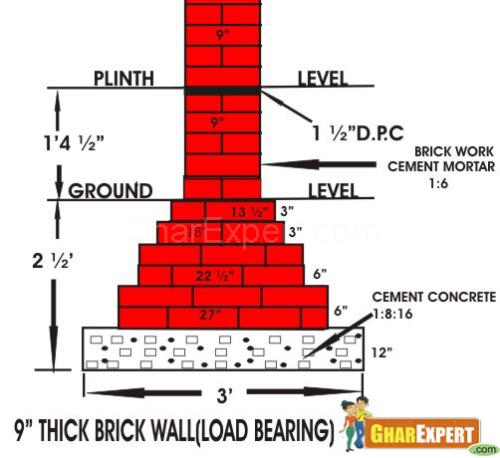
- The width and depth of the trenches depends on loading and soil conditions. As the foundation is an expanded base to distribute the load coming on it over a large area on ground. The width of the wall foundation depends on whether the wall is a load bearing wall, a non load bearing wall, a partition wall or a toe wall.
Load Bearing Walls
The walls that support beams and roof slabs.
- These walls take the load of super structure and transmit it to the ground through foundation.
- These can also serve the purpose of dividing the space into required rooms etc.
- These are also accommodating door and windows where required.
- These are of 9” or more thickness.
- Such walls are made in first class bricks and rich mortar.
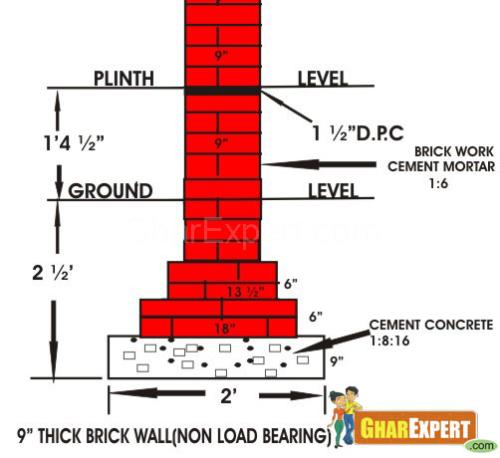
Non Load Bearing Walls
- These walls serve the purpose of dividing the space into required rooms etc.
- These are also accommodating door and windows where required.
- These can be made into thin sections to save the space.
- Non load bearing walls are only partition having no load of super structure so these can be easily changed whenever required to change the space of the room.
- These walls are made 3 inches, 4.5 inches and 9 inches thick as per the requirement of the site.
Super Structure:
The word super structure used in construction work means/denotes following.- Brick work from DPC level to the roof level/slab level.
- If columns provided in drawings then RCC columns to be laid.
- Rain water pipe is to be embedded in walls.
- Fixing doors, windows and ventilators frames in walls.
- RCC (Reinforced Beam & slab for roof) including M S Steel bars according to the designs.
- Tile terracing lay with brick tiles on the top of the roof slab.
- Fixing doors and windows shutters.
- Fixing cupboard in the rooms and Kitchen etc.
- Fixing iron grills for safety of the house.
- Providing cement plaster on ceiling and walls.
- Laying floors including base coat.
 Brick work is an important part of construction work done with the help of bricks and cement mortar. It is done with different quality of bricks with different ratios of cement mortar according to the requirement.
 Kota stone flooring is a subtle blend of grandeur and luxury giving the interior and exterior a gorgeous look.......
 To get maximum ventilation and natural light in your house, make sure the building is properly oriented. Orientation of building saves energy and provides comfortable living as well. This article tells you about various factors and benefits of building orientation.
 Preview some of the most impressive pictures of kitchen from GharExpert Gallery.
 A solid roof on building is very important for everybody living in the house. The roof should be constructed in a way that assures you great safety. Here are given details about different types of roofing.
 Frames of doors and windows are most important parts of your doors and windows. They are available in different size, height, width and shapes. Frames hold locks and hinges and support door and windows to shut and open easily. Here is what you need to know about different doors and windows frames.
 Different steel bars are recommended for their relative tensile stresses.Steel bars are major components of construction.Here is what you need to know about steel bars (Sariya).
 Brahmasthan is a powerful zone of the house. It should have open space for flow of energy in the house. The positive energy is very useful for living beings of the occupants of the house.
Brick work is an important part of construction work done with the help of bricks and cement mortar. It is done with different quality of bricks with different ratios of cement mortar according to the requirement.
Brahmasthan is a powerful zone of the house. It should have open space for flow of energy in the house. The positive energy is very useful for living beings of the occupants of the house.
Brick work is an important part of construction work done with the help of bricks and cement mortar. It is done with different quality of bricks with different ratios of cement mortar according to the requirement.
 Are you remodeling your bathroom? Bathroom shower doors make your bathroom a style icon. Read the following article that will help you select the bathroom shower door that will exactly suit your bathroom.
 Living room or Drawing room should be located in east or north direction. The ideal location of a living room depends on plot facing.

Cement Concrete and Brick Work in Foundation of Wall

Brick Wall & Cement...

Embellish your living room with exposed brick walls

Brick wall

Thick Brick Wall ( load Bearing)

Living Room with Brick Wall Texture

exposed brick wall design

brick wall design

brick wall texture

Compact living room 3 D design with brick wall cladding

Exclusive style of LCD wall design with wall to wall wooden cladding

living room sectional, wall decor, wall unit, wall mirror

Spacious Bathroom Interior, Flooring, Walls, Basin , Walls, Doors, Mirrors, Bath tub, Vanity

Bathroom Interior, Flooring, Walls, Basin , Walls, Doors, Mirrors, Bath tub, Vanity

Simple wall design with wall decals

wall decals for wall decor

Cool irregular boxes look great on wall for wall decor

Wall decals for wall decor

Bathroom Interior, Flooring, Walls, Basin , Walls, Doors, Mirrors

Bathroom Interior, Flooring, Walls, Basin , Walls, Doors, Mirrors

Wall Cladding material

Wall Design

Wall Shelves in Living Room

Bedroom

Bedroom with Wall Decor

wall design

Wall Design in Dining Room

Bedroom design

wall art

walls

wall decor

Wall Architectural Pieces

kids bedroom

Wall Decals

Music theme on walls

Wall Art and Decor

Funky bedroom with chalk board walls

TV unit and wall decoration

Wall Decor with Lights

Wall Cladding with Shelves Space

Living Room Partition Wall

boundery wall

LCD Wall unit

Wall

wall

Construction Material Brick

Wall Stickers

Living room Ceiling, Lighting, LCD unit, Wall Unit, Furniture and Flooring

Excavation of Wall

the colour contrast of a wall is gud.

Dining room ceiling, wall painting, curtains, Lighting, furniture

Wall Paint Design for Kids Room

Bedroom design with Dark Wall

Dressing Table wall mount
Bathroom Interior, Flooring, Walls, Basin , Walls, Doors, Mirrors

Decorate your LCD Wall

Bedroom concept with backlit wall

Wall Cladding Design

Wall Paintings

wall

Wall Decoration and LCD Unit

wall Art

LCD Unit with Wall Shelves

Living room wall unit design

Bathroom Wall paper design

A beautiful drawing room design with good ceiling and wall decor

Texture Bedroom Wall Paint