Basement Walls

Basement walls and design differ from other structural walls because in the basement inside of wall have living space and earth filling on the outside of wall i.e. why these are structurally designed as retaining walls to overcome the lateral pressure of outside filling of soil/earth.
Types of basement walls in construction according to the material use in the construction of wall:
- Brick wall,
- Cement Concrete Wall or RCC wall and,
- RCC wall abating the brick wall.
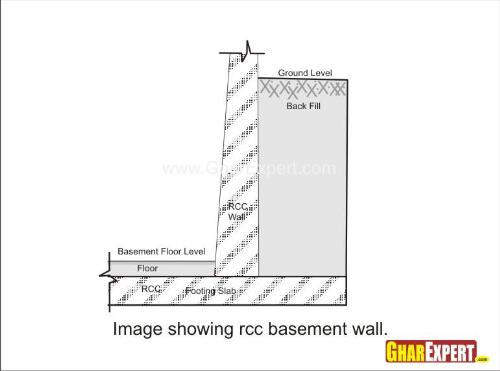
The basement walls are either load bearing to bear the load of super structure or as non load bearing walls. In case of non load bearing walls, the load of the super structure is bear by the beams which are resting on the columns. The concrete is good in compression but weak in tension due to this fact when super structure load comes on wall than the wall become out of plumb and hence cause wall failure. Similar is the case in the long and high or tall wall. So avoid this situation cement concrete wall is strengthening with the MS steel bars and thus it is known as RCC wall.
As stated above that the basement outer walls are act as retaining wall and it is some time called as cantilever retaining wall because it is free standing structure without lateral supports at top. The lateral pressure at the top of basement wall is minimum and increased with the depth and maximum at the bottom. The forces created by the earth may push the basement wall forward or over turn when it is not designed well/ properly. While designing the basement wall, all the forces should be taken in to consideration such as earth pressure, rain water effect and vibratory pressure due to side traffic. The width of foundation is increase from top level of earth up to the bottom of the foundation and the width should be maximum at bottom. In general terms the basement wall should be safe against excessive foundation pressure, sliding and over turning.
Precautions for Foundation Design of Basement Wall:
- Before designing the foundation of basement wall one should collect the design data required for designing the foundation of wall such as super structure load and characteristics of the ground. This will help to obtain economy in construction work and safety of structure.
- At the time of designing the basement foundation wall care should be taken to calculate the all the load which are to be bear by the foundation. The load bear by the foundation are the combined dead load, imposed load and wind load and these load are transmit by the foundation to the ground.
- The safe bearing capacity of the soil should be sufficient to bear the net loading intensity pressure coming on the soil or in other words the safe bearing capacity of soil should be more to the net loading intensity of pressure coming on it.
- The design of foundation should be done keeping in view minimizing the settlement on the base of foundation and it should be uniform under the whole of the building to keep away from any damage to the building /structure.
- During designing process safe bearing capacity of soil should be well studied and care should be taken that design the building accordingly as submerged soil and clay have less bearing capacity where as dry coarse and well graded dense sand have maximum bearing capacity and shear resistance which will give very economical and safe design for structure.
- In designing process the ratio of base coat i.e. foundation concrete should be 1:4:8 and brick masonry cement mortar should be 1:4 to 1:6 as loading condition.
- Where RCC structure is to be constructed than the ratio of concrete used as 1:2:4 or 1:1.5:3.
Precautions during Construction of Basement Wall:
1. Excavation of Foundation Work:
- During the excavation of foundation care should be taken that depth and width of foundation should match the structural design.
- If there is no any design of foundation then keep the depth of the foundation at least one meter from the bottom of basement.
- Mark the center line and fix the level on the BURJIS and check the length, width and depth of excavation accordingly as stated in layout of building.
- Check details regarding building layouts at the link given below:
http://www.gharexpert.com/articles/Layout-House-Plans-1512/Layout-Building_0.aspx
2. Care should be taken that no any excavated material/ earth should be dumped at a distance of 1 meter from the edges of the excavated wall on either side.
3. The construction work i.e. laying foundation concrete should be done on dry soil.
4. For emergency i.e. in case of rain water, there should be arrangement of water pump for pumping out rain water.
5. After excavation, it should be ensure that the bottom layer of the foundation should be compacted.
6. Check the bottom layer and ensure that there should be no soft places in foundation and free from roots of tree.
7. If found any soft/ defective spots or roots of tree, it should be dug out and the pit must be filled with concrete/ hard material.
Precautions for Construction of Basement Wall:
- During rainy season excavation for ‘Basement’ wall should not be taken.
- At the time of construction of basement it should be ensured that there is no any damage to the adjoining structure.
- During the construction of basement, one should have arrangement of water pump, for pumping out of water either from rain or any leakage or breakage in pipe line.
- The depth of foundation should be at least 5 feet below the floor level of the basement.
- The walls of basement should be damp proof to prevent any seepage/dampness.
- The details of damp-proofing of basement walls are given in the article Water Proofing Treatment for Basement at the link given below:
http://www.gharexpert.com/articles/Basement-1505/Water-Proofing-Treatment-Basement_0.aspx
 Basement Flooring need extra care because of moist and dampness conditions. Read details about basement flooring options and precautions you need to take while choosing flooring for basement.
 Finish your Basement Ceiling with great ideas from GharExpert ceiling design gallery. Make your basement more inviting with the right choice of ceiling design. Get new style and defination to your basement.
 Do you want to make your home a multi-purpose location? Design a basement to serve various purposes like gym, home office, living room etc. Before you begin to design interiors of the basement of your house, you need to know basement interior design ideas and various problems of basement design.
 Basement interior design can fulfill your dreams of enjoying more space. You can highlight dark space of basement in effective ways. Read this article to know more 'Basement Interior Design’ and 'Basement Design Principles' .
 Construction of basement and multi storey building is the need of the hour as there is less availability of land and rates of the land are very high. We get additional usable space by constructing either basement or upper floor.
 Basement serves the purpose of extra space and provides strong base for upper storey.
 A dry basement is a fun place to have. Usually home owners do not care for proper design of the basement at the time of construction and face tremendous problems later on. If care is taken initially, a lot of problems can be avoided.
 Kota stone flooring is a subtle blend of grandeur and luxury giving the interior and exterior a gorgeous look.......
 To get maximum ventilation and natural light in your house, make sure the building is properly oriented. Orientation of building saves energy and provides comfortable living as well. This article tells you about various factors and benefits of building orientation.
 Preview some of the most impressive pictures of kitchen from GharExpert Gallery.
 A solid roof on building is very important for everybody living in the house. The roof should be constructed in a way that assures you great safety. Here are given details about different types of roofing.
 Frames of doors and windows are most important parts of your doors and windows. They are available in different size, height, width and shapes. Frames hold locks and hinges and support door and windows to shut and open easily. Here is what you need to know about different doors and windows frames.
 Different steel bars are recommended for their relative tensile stresses.Steel bars are major components of construction.Here is what you need to know about steel bars (Sariya).
 Brahmasthan is a powerful zone of the house. It should have open space for flow of energy in the house. The positive energy is very useful for living beings of the occupants of the house.
 Brick work is an important part of construction work done with the help of bricks and cement mortar. It is done with different quality of bricks with different ratios of cement mortar according to the requirement.
 Are you remodeling your bathroom? Bathroom shower doors make your bathroom a style icon. Read the following article that will help you select the bathroom shower door that will exactly suit your bathroom.
 Living room or Drawing room should be located in east or north direction. The ideal location of a living room depends on plot facing.

Basement Concrete Wall

Basement Concrete Wall

Basement RCC Wall

living room sectional, wall decor, wall unit, wall mirror

Exclusive style of LCD wall design with wall to wall wooden cladding

basement foundation for story building .

Basement

basement

pit for basement

Basement and Underground

Fireplace in Basement

Library in Basement

Playroom in Basement

Basement, Ground and first floor planning

Basement

Gym in basement

Excavation for basement

basement

basement excavation

basement design

Texture Bedroom Wall Paint

A beautiful drawing room design with good ceiling and wall decor

Bathroom Wall paper design

Living room wall unit design

LCD Unit with Wall Shelves

wall Art

Wall Decoration and LCD Unit

wall

Wall Paintings

Basement Bar Ceiling

Home Gym in Basement

Wall Cladding Design

Bedroom concept with backlit wall

Decorate your LCD Wall

Bathroom Interior, Flooring, Walls, Basin , Walls, Doors, Mirrors

Dressing Table wall mount

Bedroom design with Dark Wall

Wall Paint Design for Kids Room

Dining room ceiling, wall painting, curtains, Lighting, furniture

the colour contrast of a wall is gud.

Excavation of Wall

Living room Ceiling, Lighting, LCD unit, Wall Unit, Furniture and Flooring

Wall Stickers

wall

Wall

TV unit and wall decoration

Wall Decor with Lights

Wall Cladding with Shelves Space

Living Room Partition Wall