Brick Arches

Brick arches
are ornamental ways of bridging openings which are comprised of small units bonded together around a curve or series of curves. Arches need no additional reinforcements as brick lintels do because of wedge shaped units as load increases, the unit in the arch becomes tighter.Arches offer architectural view and enhance aesthetic beauty of buildings. They are used to cover openings of door and windows and transfer the above loads to the side of walls. Various arches have been developed over centuries. This article gives details of arch designs, arch form work and precautions during construction of arches.
Brick Arches
Brick arches are mainly classified into three groups according to their construction and structure.Rough Brick Arch
In rough arches the joints are usually wedge shaped. These arches are constructed where high standard finish is not required. Such arches are constructed where plaster works are done. Bricks are not chamfered in construction of this arch.Fine Axed Brick Arch
Fine axed arches are constructed carefully by setting bricks into required shape. The bricks are cut into wedge shape properly and are constructed where fine work is required. These arches may be constructed with bricks in contrasting colors. The finished shape of this arch gives pleasing appearance.Gauged Brick Arch
Gauged arch is very ornamental and expensive. The bricks should have fine dressing before use. Also the joints between bricks should be very fine. These arches should be constructed by skilled mason who has sound knowledge of geometry.
Arch Designs
Flat Arch
A flat arch is suitable only for small spans and light load. It is constructed mainly on doors and windows in ordinary buildings. The square shape of this arch is decorative and non load bearing. Generally it is used to cover reinforced lintel which bears the load of wall from above.Circular Arch
Circular arch is suitable for long spans and can take heavy load. In past these arches were constructed over bridges but nowadays they are constructed in buildings where architectural appearance is required. They add to the beauty of buildings.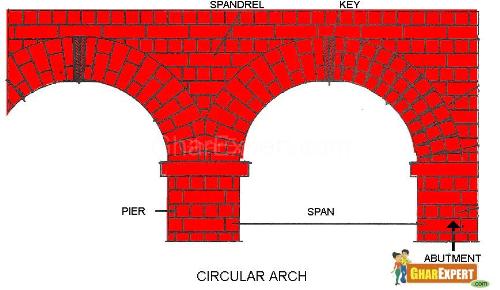
Semi-circular Arch
Semi-circular arch is very simple to construct or design as there is no complex geometry or cutting of bricks. Its semicircular shape with all the bricks facing towards the centre of the arch creates a wonderful view. Two or three rows of bricks are layered to add decorative touch to the beauty of the building.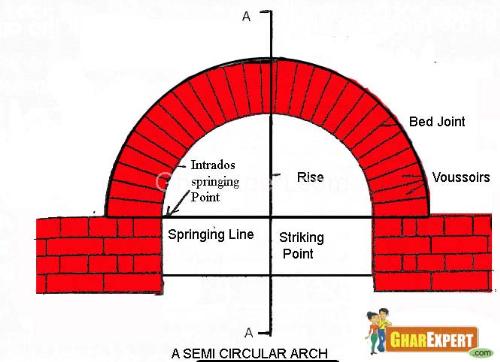
Arch Centering/Form Work
Arch centering is used for same purpose as a turning piece i.e. the temporary spot to carry arch load during construction over an opening. It is made up of a number of small sections and timber members into required shape. Arch form work can conveniently be used over large spans.
Precautions for Brick Arches
- The length and width of the arches should be according to drawings.
- The quality of bricks should be good having required strength and should not show any efflorescence (salt on face).
- There are minimum brick bats brick arches.
- The sand used for brick mortar should be of required FM (Coarser) with no silt. It should not have fine grains and be free from silt etc.
- The mixing of mortar should be proper with required quantity of water. It should not be dry or liquid.
- The bricks are soaked in water before use otherwise these will absorb water from mortar and the bonds will be weak.
- The water should penetrate to the core of bricks but the bricks should be skin dry i.e. from outside when it’s used in actual.
- The bricks are absolutely aligned horizontally and in a straight line which can be checked by a stretched string across the face. Also they are vertically aligned which can be checked with a plumb bob.
- The courses or layers of bricks are level. This can be checked with a spirit level.
- The thickness of joints is not more than 1 cm and the joints should be filled with mortar fully without any gaps.
- The joints are pushed inside when cement mortar is still wet so that later plastering can be done effectively.
- Brick work should be kept wet for seven days so that the mortar may gain its full strength.
- There are no continuous vertical joints and the bricks, sand and cement used in brick work should be according to their specifications .
 Do you know good brick bonds can ensure the strength of a building? Only you need to select appropriate bond for walls of your house. This article tells you about the options of brick bonds and their patterns.
 Doors or Windows opening in walls are skilled part of construction in home, work are or any other structure. It needs very careful and technical construction team to work on. Read more about making door or window opening here.
 Before starting brick work the following items should be checked:
What is brick tile work? What are the guidelines for labor for brickwork in superstructure? Don’t worry about all these questions and read the article to find out the solution.
While going for construction, do we know the Guideline meant for Labor for Brick Work in Super Structure? If not then read the article here.
We all know the importance of brickwork in any construction, So the article here describes the guideline meant for labor for brick work in foundation.
 Kota stone flooring is a subtle blend of grandeur and luxury giving the interior and exterior a gorgeous look.......
 To get maximum ventilation and natural light in your house, make sure the building is properly oriented. Orientation of building saves energy and provides comfortable living as well. This article tells you about various factors and benefits of building orientation.
 Preview some of the most impressive pictures of kitchen from GharExpert Gallery.
 A solid roof on building is very important for everybody living in the house. The roof should be constructed in a way that assures you great safety. Here are given details about different types of roofing.
 Frames of doors and windows are most important parts of your doors and windows. They are available in different size, height, width and shapes. Frames hold locks and hinges and support door and windows to shut and open easily. Here is what you need to know about different doors and windows frames.
 Different steel bars are recommended for their relative tensile stresses.Steel bars are major components of construction.Here is what you need to know about steel bars (Sariya).
 Brahmasthan is a powerful zone of the house. It should have open space for flow of energy in the house. The positive energy is very useful for living beings of the occupants of the house.
 Brick work is an important part of construction work done with the help of bricks and cement mortar. It is done with different quality of bricks with different ratios of cement mortar according to the requirement.
 Are you remodeling your bathroom? Bathroom shower doors make your bathroom a style icon. Read the following article that will help you select the bathroom shower door that will exactly suit your bathroom.
 Living room or Drawing room should be located in east or north direction. The ideal location of a living room depends on plot facing.
Without knowing perfect mixture of cement and sand you can not achieve your goal.
Manufacturing date, grade and type play vital role in purchasing right cement and there should be no lumps in it.
First Class Bricks must be homogeneous in texture without showing appreciable sign of efflorescence.
A coupler connects the two pipes to each other. If the material and size of the pipe are not the same,it is called a 'reducing coupler'.
Best of Brick Arch

brick arch

Arch Design

Arch design

Arch design

Arched French Window

Arched ventilation

Arch

Elevation design 9 Arch Lattice

Elevation design 8 Arch Lattice

Elevation design 5 Arch Lattice

Elevation design 4 Arch Lattice

Elevation design 3 Arch Lattice

Elevation design 2 Arch Lattice

Elevation design 1 Arch Lattice

Kitchen design Arch Lattice

arch

arch

arch

ARCH EXT.
Best of Brick Arch

brick style

Thick Brick Wall ( load Bearing)

Arch design in lobby with wooden flooring and traditional dining furniture

brick work and truss

Brick Light

arch

An empty room in design style with an arch
Arched French Window
Arched ventilation
Arch
Arch Design
Arch design
Arch design
ARCH EXT.

ARCH EXTERIOR.

arches
Elevation design 9 Arch Lattice
Elevation design 8 Arch Lattice
Elevation design 5 Arch Lattice
arch

Construction Material Brick

Wooden entrance door design with arch

arched window

Wooden Arch

entrance arch

arched window dressing

entrance arch

Nice Brick Work

Brick Work On DPC

Compact living room 3 D design with brick wall cladding

arch window

Cement Concrete and Brick Work in Foundation of Wall
Kitchen design Arch Lattice

arch ceiling
Elevation design 4 Arch Lattice

Arched design for the main entrance of house

arched window

Columns and arches used as design elements

arched window with decorative rod

Wooden door with carved moldings and arched ventilator at the top.jpg

brick

brick wall design

Wooden framed glass panel door with arched transom with sidelite

arched tall window

beautiful arch

large arched window

arched window sheer

Living Room Ceramic Floor Tile in Brick Design

Entrance arch design
Copyright 2007-
GharExpert.com All rights reserved.