Water for Construction

Water is one of the most important elements in construction but people still ignore quality aspect of this element. The water is required for preparation of mortar, mixing of cement concrete and for curing work etc during construction work. The quality and quantity of water has much effect on the strength of mortar and cement concrete in construction work.
Quality of Water
The water used for mixing and curing should be clean and free from injurious quantities of alkalis, acid, oils, salt, sugar, organic materials, vegetable growth and other substances that may be deleterious to bricks, stone, concrete or steel. Potable water is generally considered satisfactory for mixing. The pH value of water should be not less than 6.
Effects of Bad Quality Water on Cement Concrete
It has been observed that certain common impurities in water affect the quality of mortar or concrete. Many times in spite of using best material i.e. cement, coarse sand, coarse aggregate etc. in cement concrete, required results are not achieved. Most of Engineers/Contractors think that there is something wrong in cement, but they do not consider quality of water being used. Some bad effects of water containing impurities are following.
- Presence of salt in water such as Calcium Chloride, Iron Salts, inorganic salts and sodium etc. are so dangerous that they reduce initial strength of concrete and in some cases no strength can be achieved. There is rusting problem in steel provided in RCC.
5. Presence of algae/vegetable growth in water used for mixing in cement concrete reduce of the strength of concrete considerably and also reduce the bond between cement paste and aggregate.
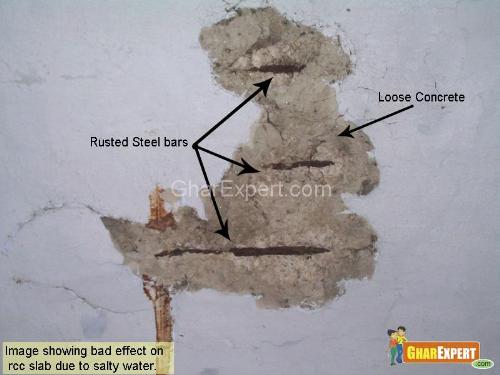
Don't let this happen in your home. Use quality water for construction.
Caution: It has been observed at various places that cement concrete start falling down in pieces after rusting mild steel from RCC slab, which is due to use of bad quality/salty water in RCC slab. All this is due to negligence or ignorance which creates great problems and also bears a heavy loss. It is advisable that the water must be tested before using in construction work.
How to test water and what should be tested
It is recommended that the water is tested through a certified lab. The water should confirm the standard IS: 3025-1986 which is briefly described below.
- Limit of Acidity: To neutralize 200 ml sample of water, use phenolphthalein as an indicator. It does not require more than 2 ml 0.1 normal NAOH.
- Limit of Alkalinity: To neutralize 200 ml sample of water, use methyl oil as an indicator, it does not require more than 10 ml 0.1 normal HCL
Limit of Solids
- Organic: 200 Mg per liter
- Inorganic: 3000. Mg per liter
- Sulphate: 400 mg per liter
- Chloride: 500 mg per liter for RCC work and 2000 mg per liter for concrete not containing steel.
- Suspended matter: 2000 mg per liter
Physical and chemical properties of ground water should be tested along with soil investigation and if the water is not found conforming to the requirements of IS: 456-2000, it should not be used. The water found satisfactory for mixing is also suitable for curing. However the water used for curing should not produce any objectionable stain or unsightly deposit on the surface. The presence of tannic acid or iron compounds in water meant for curing is objectionable. Sea water should not be used for mixing or curing.
It is a common thinking in construction work that the water fit for human consumption is generally acceptable for mixing mortar or concrete and curing work. However, the water must be tested before using in construction work. When you are making huge expenditure on construction work, a negligible amount spent on water testing should not be saved. Tested water or treated water should be used as this will increase the strength of cement concrete and enhance the life of building.
Treatment of Water: It is advisable that water should be tested in lab and if found unsatisfactory, it should be treated according to directions of laboratory. It is generally observed that ground water has some quantities of salt. In case of small work or in a situation where good water is not available, salty water must be treated with HCL @ 10 ml for 100 liters of water.
Quantity of Water: Water is an important component for mortar or concrete. The quantity and quality of water have much effect on the strength of mortar and cement concrete. It has been observed many times that in spite of using best raw materials, cement and tested water; concrete does not provide required results. Engineers/contractors think that there is something wrong in cement, but they do not consider water cement ratio or quantity of water added in the mix.
When the water is mixed in mortar, it reacts with cement and forms a binding paste which fills small voids in the sand. This creates a close cohesion of sand particles and cement. In case of cement concrete the voids formed between sand and coarse aggregate gets filled with the paste forming a cohesive substance/concrete. The required quantity of water is used to prepare mortar or concrete, but in practice it is seen that more water is mixed to make the mix workable. This is a bad practice and additional water weakens the strength of cement paste. Extra water also weakens adhesive quality.
Main disadvantages of mixing too much water in mortar and concrete
- The water occupies space in sand and it evaporates to create voids. Moreover the water voids will be more and this will reduce the density, strength and durability of mortar or concrete.
- When more water is used in concrete excess water brings a mixture of excess cement paste with water floating on the surface. This material forms a thin layer of chalky material on the surface which reduces proper bonding with second layer of cement concrete in case of water tank and dams etc. This will affect the strength of concrete.
- When more water is used, the cement slurry starts coming out from from cement concrete mix. The excess slurry formed by water and cement comes out through shuttering joints. This makes concrete of less cement and reduces the strength of concrete.
- When more water is used, proper compaction is not achieved and there is bleeding, large voids and more shrinkage, less durability and less strength.
- When more water is mixed in cement concrete, the problem of segregation of material is faced at the time of laying the mix. As a result Coarse Aggregate and cement paste separate from each other.
Hence strict control should be kept on water cement ratio for preparing the mortar or concrete for qualitative finish/ strength.
Quantity of Water for One Bag Mix
- Approximate 32 liters of water is required where the ratio 1:2:4 of cement concrete is used.
- Approximate 30 liters of water is required where the ratio 1:1.5:3 of cement concrete is used.
Water for Cement Concrete
- Water for ordinary cement concrete mix should be equal to 5% by weight of aggregate and 30% by weight of cement.
- The actual quantity of water required to be added in the field depends on availability of aggregate and surface water present in the aggregate.
- It should be calculated by slump test.
- Generally for vibrated concrete the quantity of water is less by 20%.
Water Reducing Admixtures
The water reducer admixture improves workability of concrete/mortar for the same water cement ratio. The determination of workability is an important factor in testing concrete admixture. Rapid loss of workability occurs during first few minutes after mixing concrete and gradual loss of workability takes place over a period from 15 to 60 minutes after mixing. Thus relative advantages of water reducing admixture decrease with time after mixing. These admixtures increase setting time by about 2 to 6 hours during which concrete can be vibrated. This is particularly important in hot weather conditions or where the nature of construction demands a time gap between the placements of successive layers of concrete.
Advantages
- It can reduce 10% of water consumption.
- It can improve mixture of cement concrete for workability.
- Compression strength improves by more than 15 %.
- It can reduce initial stage of cement heat hydration by large margin.
- It has no function of corrosion reinforcing bars.
- It increases workability, density and strength without increasing the quantity of cement.
Hence in the area where there is less availability of water and the water is carried from long distances for construction work, the water reducing admixture is most beneficial for cement concrete work as it saves water up to 10%. It also increases the strength of cement concrete with the same quantity of cement.
Note: - pH Value: A method of expressing differences in the acidity or alkalinity of a solution. A figure of 7 is regarded as neutral; figures below this indicate the decree of acidity and above alkalinity.
 Storage of water in proper way is essential for drinking, cleaning, bathing, cooking purposes in our day-to-day life. We use water tanks for storage purposes. Read this article to know about various types of water tanks and how to construct them.
 Kota stone flooring is a subtle blend of grandeur and luxury giving the interior and exterior a gorgeous look.......
 To get maximum ventilation and natural light in your house, make sure the building is properly oriented. Orientation of building saves energy and provides comfortable living as well. This article tells you about various factors and benefits of building orientation.
 Preview some of the most impressive pictures of kitchen from GharExpert Gallery.
 A solid roof on building is very important for everybody living in the house. The roof should be constructed in a way that assures you great safety. Here are given details about different types of roofing.
 Frames of doors and windows are most important parts of your doors and windows. They are available in different size, height, width and shapes. Frames hold locks and hinges and support door and windows to shut and open easily. Here is what you need to know about different doors and windows frames.
 Different steel bars are recommended for their relative tensile stresses.Steel bars are major components of construction.Here is what you need to know about steel bars (Sariya).
 Brahmasthan is a powerful zone of the house. It should have open space for flow of energy in the house. The positive energy is very useful for living beings of the occupants of the house.
 Brick work is an important part of construction work done with the help of bricks and cement mortar. It is done with different quality of bricks with different ratios of cement mortar according to the requirement.
 Are you remodeling your bathroom? Bathroom shower doors make your bathroom a style icon. Read the following article that will help you select the bathroom shower door that will exactly suit your bathroom.
 Living room or Drawing room should be located in east or north direction. The ideal location of a living room depends on plot facing.

Use of bad quality water in construction cause this.

PVC Water Stopper

Water Consumption

Water tank distance

Water tank cover

under water bedroom...

under water bedroom

Cherapunji - Water Falls

Location of Water Sump

Water fountains-Another key feature for your garden

Water bed

Water seal

Overhead Water Tank

RCC water Tank

Under Ground Water Tank

Rain Water Pipe

Rain Water Drainage

water garden

water fall

Water droplet resort
Use of bad quality water in construction cause this.

Plumbing Piping layout at the time of construction

Raw construction of house

Main Gate for society raw construction

construction work

main door under construction

start construction

start construction

start construction

start construction

water falls

water falls

construction

construction material trading

construction work

Walkway on the new construction

Basement Construction

Construction Material

Construction Material & Equipment

Construction Material & Equipment

little swimming pool and water fall

Sloped roof house exterior under construction

Under construction 2 story building

Construction of Road

sump construction
Water seal

ceiling under construction

Roof Construction

Roof Construction in progress

Under Construction

Construction Work with pipes

marking on construction site
Location of Water Sump

roof tiles

Tallest building of delhi under construction

Construction Of Front part of home

Wall Construction

Under water world kids room paint ideas
Rain Water Pipe

Under construction elevation front picture

Picture of Twin home under construction front-house-elevation

slab construction on site

Exterior View of house under construction

Construction Material Brick
under water bedroom

Construction of house

Steel Bars For RCC Work

Exterior view of house under Construction work

Construction of House

door