Bamboo Flooring

|
Bamboo flooring is manufactured from “Moso” species of bamboo plant so it is environment friendly. Bamboo flooring is gaining popularity day by day. It is easy to install and is also good for those who suffers from allergy because bamboo flooring do not encourage dust etc. |
 “Moso” species of bamboo. |
There are many types of bamboo flooring; which differs in its manufacturing process and is based on economic viability and local preferences.
Thin bamboo stems are most commonly used. They are cut to similar lengths and can be stained, varnished, or simply used. They are nailed down to wooden beams or bigger pieces of bamboo stems. This form results in more space between each bamboo stem, flatness and tightness is not emphasized. This technique is usually used on stilted houses, resulting in better air circulation especially during the warmer summer months.
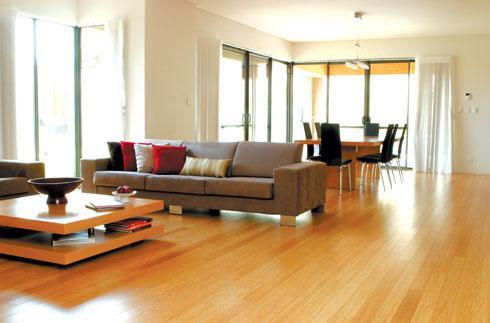
(This Picture is Contributed by "Condeliza")
Bamboo-mania
The other types of bamboo flooring is made with the bamboo by spliting and flattened, dried, and then laminated in layers with glue under high pressure. Manufactured bamboo floors are typically made available in planks with either vertical- or horizontal-grain orientation.
Strand woven bamboo flooring is another type of bamboo flooring which is prepared with strand bamboo which are woven and treated with adhesive. The material is compressed until it setup. After this it is cut according to the requied length for flooring.
Installation of Bamboo Flooring
Installation of bamboo flooring should be done with care by skilled workers who know their job very well. Defective installation can spoil the look of bamboo flooring and reduce the durability of flooring. Installation steps of bamboo flooring are given below.
1. Base Coat under bamboo flooring:
Before you lay bamboo flooring the base coat should be laid as follows.
- Earth should be compacted properly with the help of watering and ramming.
- Sand piling should be done which will help to ensure proper compaction of the earth under floor.
- Lay 100 mm thick fine sand on compacted earth.
- After laying fine sand, lay 100 mm thick cement concrete in the ratio 1:8:16.
It must be ensured that the base coat laid is fully compacted by the hand rammers or with surface vibrator
2. Leveling Concrete for Bamboo flooring:
- A layer of leveling concrete should be at least 25 mm thick.
- Cement concrete should be in ratio of 1:2:4.
- It should be laid in proper slope and in level.
- It should be perfectly compacted.
- It should be cured for 7 days.
3. While Laying Bamboo Flooring:
Before starting laying bamboo flooring, the planks should be tested according to the requirement of bamboo flooring.
- After dring the leveling concrete surface, the surface should be cleaned before lying the floor.
- Bamboo floor is fixed by nailing process in which the planks are laid down and nailed or steppled to the sub floor.
- Bamboo floor also laid by floating floor method in which bamboo planks are laid on sub floor and bamboo planks clicked (joined) or glued together. This flooring gives cushion like feel.
- Bamboo flooring is also laid by gluing down concrete floor. First the concrete floor is leveled by leveling compound. Clean the surface of floor of any dirt or chemical or any oily substances which may react with the floor. Then bamboos flooring planks or tiles are laid on the glue applied on concrete surface.
- The layout of bamboo flooring is simple process; and one can lay this flooring by using necessary tools.
- The material of bamboo flooring should be stored at least for one week at the site before fixing to get atmospheric moisture.
Advantages of Bamboo Flooring
- Bamboo flooring are that it is light in weight.
- Bamboo flooring is very easy to clean and maintain.
- It is durable and hard.
- It has an attractive look.
- Bamboo flooring is not too cold during winter season and not too hot in summer season.
- Raw material used for bamboo flooring is easily available.
 Epoxy flooring can be defined as several layers of any type of epoxy resin that is applied on a floor surface. This type of flooring may be used on both on the flooring of homes and Industries. Epoxy flooring has many advantages as it is slip resistance, durable, clean and easy to maintain and it comes in several colors as clean white, slate and silver grey and can also have a specific color.
 A nice flooring lets your feet walk on it comfortably as well as adds to the beauty of the home. Flooring also reflect your lifestyle and traits. So dont go blindfolded for choosing the flooring. Here are details of diiferent types of flooring trend
 Cork is a new option for flooring these days. Cork is made from oak tree and gives a natural feeling for flooring in home or for your work area. Find out more about cork flooring right here.
 Terrazzo flooring is popular for residential as well as public buildings since it is not slippery when wet.
 Hardwood flooring is one of the expensive yet elegent flooring option. Its installation is not that typical but still needs a lot of care as a flooring not done carefully could get damaged quickly.
 Concrete Flooring is one of the most cost efficient flooring techniques available to a home owner, here is all you will need to know for laying the cement concrete flooring.
 The type of flooring you choose depends on the location you are using it for. But if you are confused about the selection of best flooring for your rooms like what to choose for bedroom, bathroom, children’s room and so on, this write-up is just for you.
 Proper maintenance of flooring is required to retain the beauty of floors and home as well. The flooring preserved nicel
 Flooring whether in drawing room or in living room is basic component and a good design of floor not only looks elegant but also reflects your life statement. Ceramic tiles are a good option for designer flooring. Find out more ceramic tiles flooring here.
 Crazy marble floor is suitable for Drive way, Courtyard, Verandah etc. When marble flooring is installed in the main building the wastage and cut pieces can be utilized in laying this flooring.
 Kota stone flooring is a subtle blend of grandeur and luxury giving the interior and exterior a gorgeous look.......
 To get maximum ventilation and natural light in your house, make sure the building is properly oriented. Orientation of building saves energy and provides comfortable living as well. This article tells you about various factors and benefits of building orientation.
 Preview some of the most impressive pictures of kitchen from GharExpert Gallery.
 A solid roof on building is very important for everybody living in the house. The roof should be constructed in a way that assures you great safety. Here are given details about different types of roofing.
 Frames of doors and windows are most important parts of your doors and windows. They are available in different size, height, width and shapes. Frames hold locks and hinges and support door and windows to shut and open easily. Here is what you need to know about different doors and windows frames.

Bamboo flooring in kitchen

bamboo floor in living room

bamboo flooring

Bamboo exterior elevation for rustic style house

bamboo strips paint ideas for bathroom

Bamboo Roofing

Bamboo Roofing

Bamboo Roofing

Bamboo Roofing

Bamboo Roofing

Living area- Bamboo Furniture

Bamboo Bed

Exterior Bamboo Cladding

Chinese Bamboo Design Door Curtain

Eastern Bamboo Joss Fabric Shower Curtain

Bamboo light

Bamboo Roofing

Bamboo

Bamboo Concept

Bamboo Furniture
Bamboo flooring in kitchen
bamboo flooring
bamboo floor in living room

Wooden flooring on stairs and flooring

Living Room LCD unit, Furniture, wooden Flooring, Carpet, Floor Lamp

Kota stone Flooring in exterior flooring

Bamboo Screen Room Divider

Bamboo candle stands

Bamboo Ceiling Fan

Bamboo Work on the Roof

Bamboo Room Divider

Bamboo Roll on Blinds
Bamboo Furniture
Bamboo Concept

Kitchen service open with Bamboo tile wall cladding

floor plan

Wooden flooring in drawing room

Living Sofa and Wooden Flooring

Basement, Ground and first floor planning

2BHK First Floor Plan

floor mate

Bathroom Planning, Ceiling, Lighting, Vanity, Flooring, Bath tub and Interior

Decorative Lights in Luxrious Bedroom

modren bed room

Bathroom Interior, Flooring, Walls, Basin , Walls, Doors, Mirrors

Kitchen

Vinyl Flooring Design

Living room Ceiling, Lighting, LCD unit, Wall Unit, Furniture and Flooring

Perimeter Border Flooring
Contemporary living room

FLOORING

Kitchen Interior with Brown Concept

red colored tiles on floor in Dining room

Kids room interior, wardrobe, flooring, ceiling, furniture design

Living Room Ceiling and Flooring

kitchen flooring

Hardwood flooring with steel strips for open kitchen and living room

Flooring 3

Patio flooring

flooring

Ground Floor Elevation

Modern simple Bedroom

Elevation for Ground floor Bungalow

White Marble Tile Kitchen Floor

Bedroom Decoration and flooring

ROOF N FLOOR

celling

Ceiling and flooring design for lobby

Bedroom Interior

Marble floor design